There is a distinct phase every orchid hobbyist goes through. You start with a supermarket Phalaenopsis, keep it alive, and watch it rebloom. Suddenly, the bug bites. You begin looking beyond the moth orchids, craving something with different shapes, bolder colors, and a bit more of a challenge. You become not just a grower, but a collector.
If you are currently in that phase, scanning nurseries and websites for the plant that will define the next level of your collection, stop scrolling. You need a Vanda ampullacea.
For decades known as Ascocentrum ampullaceum, this species recently underwent a taxonomic shakeup that landed it squarely in the Vanda genus. But regardless of what the tag says, this plant is a legend among enthusiasts. It is a miniature powerhouse that delivers an aesthetic punch far outweighing its diminutive footprint.
A 2,000-word deep dive into a single small plant might seem excessive, but the Vanda ampullacea is no ordinary orchid. It is a cornerstone species that bridges the gap between beginner windowsill growing and advanced greenhouse culture.
Here is a comprehensive look at why this dazzling miniature is absolutely essential for anyone serious about building a diverse and stunning orchid collection.
1. The Aesthetic Triumph of the Miniature
In the world of orchid collecting, space is almost always the limiting factor. We all dream of massive conservatories filled with giant Grammatophyllums or towering standard Vandas with four-foot root systems. The reality, however, is often a windowsill, a cramped grow tent, or a small patio.
The “miniature orchid” trend isn’t just a fad; it’s a practical necessity for modern collectors. But downsizing shouldn’t mean sacrificing impact. This is where Vanda ampullacea shines.
The “Jewel Box” Effect
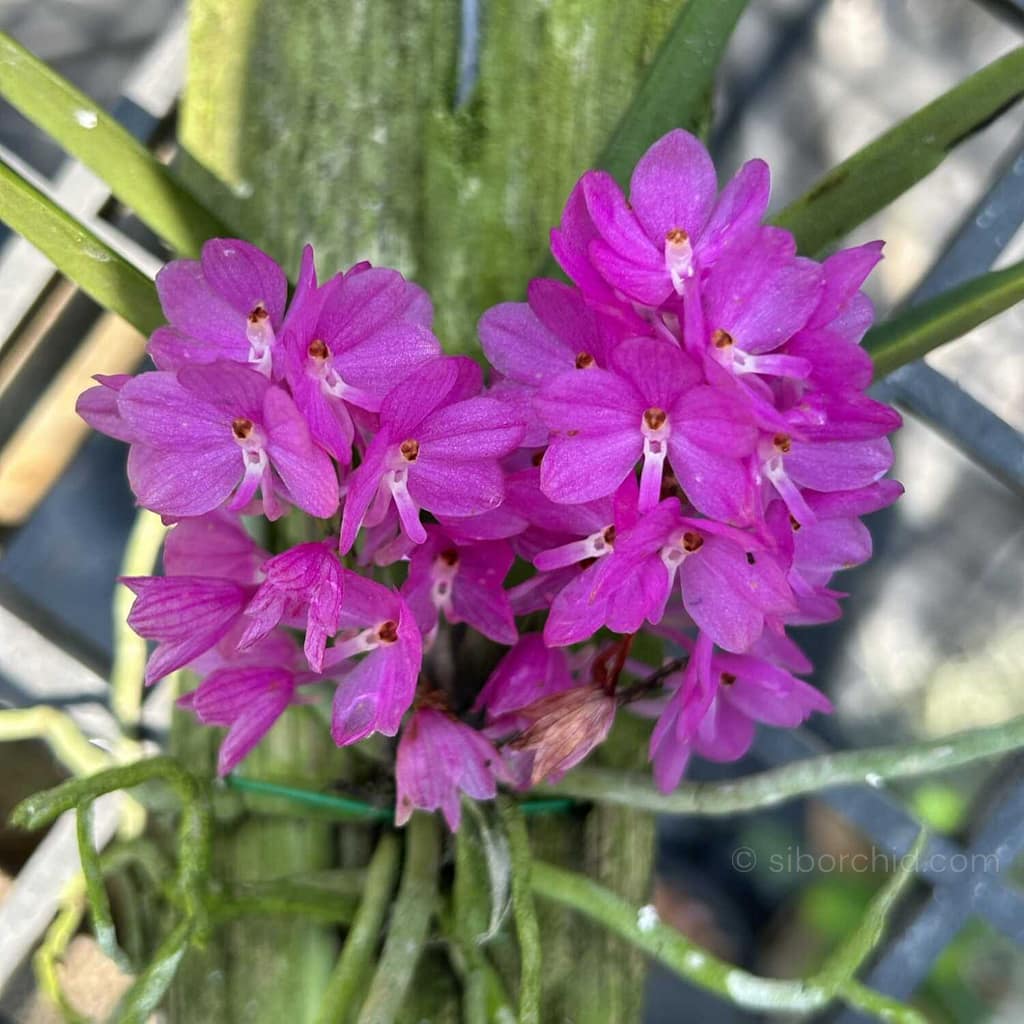
Vanda ampullacea is often described as a “jewel box” orchid. The plant itself is compact, rarely exceeding 6 to 8 inches in height. It features stiff, channeled leaves that grow in a neat, monopodial fan structure (growing upward from a single point), which is architecturally pleasing even when not in bloom.
But when it does bloom, usually in late winter through spring, it transforms. It produces multiple upright axillary inflorescences. Unlike the arching spikes of a Phalaenopsis, these spikes stand straight up, shorter than the leaves, packed tightly with flowers.
The result is a dense cluster of brilliant, crystalline blooms that look almost artificial in their perfection. The colors range from a soft, dusky rose pink to an intense, almost vibrating magenta or deep fuchsia. Because the flowers are so tightly packed, a mature specimen in full bloom looks like a solid sphere of intense color nestling in the crown of the plant.
The Scale Perspective
For a collector, scale is everything. A giant Vanda looks impressive from across the room. A Vanda ampullacea, however, invites intimacy. It demands that you get close. It’s an orchid that looks incredible on a coffee table or mounted at eye level on a growing rack. Its small stature means you can fit five or six of them in the space of one standard Cattleya, allowing for more genetic diversity in a limited area.
2. A Living Lesson in Orchid Taxonomy (The Ascocentrum Shift)
Serious collectors love the history and science behind their plants. Owning a Vanda ampullacea is like owning a piece of modern botanical history.
If you look at older orchid books or speak to growers who have been in the hobby for 30+ years, they will invariably call this plant Ascocentrum ampullaceum. For a long time, the genus Ascocentrum was separate from Vanda, distinguished primarily by smaller flower size and the presence of a distinct spur at the base of the flower lip.
However, recent advances in molecular phylogenetics (DNA sequencing) have revolutionized how we categorize orchids. The science revealed that Ascocentrum species were nestled so deep within the Vanda DNA family tree that keeping them separate didn’t make evolutionary sense.

Why This Matters to a Collector
Why should you care about a name change? Because it tells you exactly how to treat the plant.
By reclassifying it as a Vanda, botanists confirmed what many astute growers already suspected: this plant craves the Vanda lifestyle. It wants high light, tons of air to its roots, and heavy feeding. Knowing it is a “true” Vanda helps you immediately understand its cultural baseline. It isn’t a delicate, shade-loving miniature; it’s a sun-loving warrior in a small package.
Furthermore, this species is highly significant in hybridization. It is a parent to countless “Ascocenda” hybrids (now technically just Vanda hybrids). It is used by breeders to shrink down the size of giant Vandas while injecting intense pink and red color saturation. Owning the pure species gives you an appreciation for the genetic building blocks of the modern orchid world.
3. The “Goldilocks” Zone of Culture
One of the biggest barriers to collecting standard Vandas is their demanding nature. They generally require intensely bright light and very warm, tropical temperatures year-round.
Vanda ampullacea originates from a wide swath of Southeast Asia, including the Himalayas, Myanmar, Thailand, and Laos. It is often found at elevations ranging from 1,000 to 3,000 feet.
This geographical background gifts the collector with a significantly more forgiving plant than its lowland tropical cousins.
- Temperature Tolerance: Because it grows at moderate elevations, V. ampullacea is remarkably tolerant of cooler temperatures. While it thrives in intermediate-to-warm conditions, it can handle winter night drops down into the low 50s°F (10-12°C) without throwing a fit. In fact, a slight winter cool-down often helps stimulate better blooming. This makes it much easier to grow in temperate climates or indoors than a heat-loving Vanda sanderiana.
- Light Requirements: It needs bright light—more than a Phalaenopsis or Paphiopedilum—but it doesn’t necessarily need the scorching full sun that larger terete-leaf Vandas require. A very bright windowsill with some direct morning sun, or under high-output LED grow lights, is usually sufficient to get it to bloom.
For the collector who wants to break into the Vanda alliance but is intimidated by their cultural demands, V. ampullacea is the perfect entry point. It’s the “Goldilocks” Vanda: not too hot, not too big, just right.
4. Mastering the Culture: A Collector’s Guide to Success
To truly justify why you need this plant, you need to know that you can keep it alive. While “easier” than giant Vandas, it still has specific requirements that differ from potted orchids. Mastering these is part of the joy of advancing your collecting skills.
The key to Vanda ampullacea is balancing its need for massive amounts of water with its intolerance for staying wet.

The Root System Paradigm Shift
If you are used to growing orchids in pots with bark media, you must shift your mindset. Vandaceous orchids have thick, aerial roots designed to grab moisture quickly from rain and dew, and then dry out rapidly in the breeze.
Putting Vanda ampullacea in a dense, soggy potting mix is a death sentence. Its roots need to breathe.
The Best Growing Methods for Collectors:
- Wooden Slat Baskets (The Gold Standard): This is the most popular and aesthetic way to grow them. Place the plant in a small wooden basket with little to no media. Perhaps a few large chunks of charcoal or lava rock to stabilize it, but mostly air. The roots will wander in and out of the slats. This ensures perfect drainage.
- Mounting: They look spectacular mounted on cork bark or driftwood. This mimics their natural epiphytic growth habit perfectly. However, mounted plants require daily (sometimes twice daily) watering in summer, which is a commitment.
- Coarse Clay Potting: If you live in a very dry climate (like a desert or a centrally heated apartment in winter) and baskets dry out too fast, you can use a very coarse clay pot with large chunks of inorganic media like LECA (clay pebbles) or large lava rock. The clay pot breathes, and the inorganic media won’t break down and suffocate the roots.
The Watering Ritual
This is where most beginners fail with Vandas. Because they grow with exposed roots, you cannot just “splash and dash.”
When you water a Vanda ampullacea in a basket or on a mount, you must water it until the silvery roots turn vibrant green. Then, wait a few minutes, and do it again. The outer layer of the root (the velamen) needs time to absorb the water like a sponge.
In the heat of summer, these plants are thirsty. They will likely need a thorough soaking every single day. In winter, when light levels are lower and temperatures cooler, you can back off to every other day or every three days, provided humidity remains decent.
The Hunger is Real
Vandas are heavy feeders. They grow fast during the warm season and need fuel to produce those dense clusters of flowers. Because you are watering frequently and there is little media to hold nutrients, you need to fertilize regularly.
A “weekly weakly” approach works best. Use a balanced fertilizer (like a 20-20-20) at one-quarter to one-half strength every week during the active growing season. Flush with plain water once a month to prevent salt buildup on the roots.
Air Movement: The Silent Killer Preventer
In their native Himalayan foothills, there is always a breeze. Stagnant air leads to fungal and bacterial issues, especially crown rot, which can kill a monopodial orchid quickly. Ensure your growing area has gentle, continuous air movement from a fan. If you water overhead, make sure the leaves are dry by nightfall.
5. The Ultimate Reward: Long-Lasting Blooms
Why do we put up with the daily watering and the fretful lighting adjustments? For the payoff.
When a Vanda ampullacea decides it’s happy, it is spectacular. A well-grown, mature specimen won’t just give you one spike; it can produce two, three, or four simultaneously from the leaf axils.
The blooms are incredibly long-lasting for an orchid of this type. You can expect the flowers to remain pristine for four to six weeks, sometimes longer in cooler conditions.
The visual texture of the flowers is also unique. They possess a crystalline quality, sparkling slightly under direct light. The saturation of pink/magenta is rarely matched in the orchid world without hybridization. It is a pure, unapologetic burst of color that signals the end of winter and the promise of spring.
Conclusion: The Keystone of a Collection
A collection is defined not just by the quantity of plants, but by the quality and diversity of the species within it.
Vanda ampullacea offers the collector a unique combination of traits impossible to ignore: It is small enough to fit anywhere, durable enough to forgive minor errors, historically significant enough to spark conversation, and beautiful enough to stop you in your tracks.
It is a plant that challenges you to up your cultural game regarding watering and light, but rewards you tenfold for the effort. If you are looking at your collection and feel it needs a spark of intense color and a touch of botanical history, it is time to track down a Vanda ampullacea. Your collection isn’t complete without one.