June brings long days and high temperatures, making it a critical time for orchid enthusiasts. On siborchid.com, we frequently get asked how to capitalize on this intense seasonal energy. While many common household orchids take a back seat during the peak of summer, a selective group of exotic species thrives in the heat, producing breathtaking mid-summer displays.
Managing your collection during June requires a balance of light, hydration, and air circulation. If you want a greenhouse or growing space packed with vibrant colors and rich fragrances while others are waiting for winter cycles, these 9 distinct orchid species are ideal additions to your collection.
The June Summer Orchid Lineup: Profiles & Care Requirements
Every species listed below possesses distinct physiological traits adapted to specific microclimates. Understanding their native origins is key to replicating their ideal care conditions at home.
Understanding Orchid Blooming in June
Orchid blooming is not random—it is driven by precise environmental signals such as:
- Day and night temperature fluctuations
- High humidity during monsoon transition periods
- Seasonal rainfall and root hydration cycles
- Light intensity and stable photoperiod conditions
- Maturity of pseudobulbs or canes formed in previous seasons
During June, many orchids respond to the transition into full tropical summer growth. Species native to Southeast Asia, Himalayan foothills, and tropical forests naturally synchronize their blooming cycles with this climatic rhythm.
This is why June becomes one of the richest and most visually rewarding months for orchid enthusiasts worldwide.

1. Dendrobium thyrsiflorum (The Pinecone Dendrobium)
Native to the high-altitude forests of the Himalayas and Southeast Asia, Dendrobium thyrsiflorum delivers a spectacular pendulous display in early summer. The flowers emerge in tightly packed, cylindrical racemes that mimic a pinecone before bursting open.
- Grower Tip: The stunning blooms are notoriously short-lived, typically lasting 5 to 7 days. Keep the plant in a cooler, shaded area once the buds open to maximize the display window.
- Bloom Appearance: Elegant, translucent white sepals and petals contrasted sharply by a rich, golden-orange, velvety lip.
- Light Requirements: Bright, filtered light. It benefits from morning sun but requires protection from intense midday rays.
- Temperature: Intermediate to warm during the summer growth season.
- Watering Needs: Heavy watering and regular fertilization throughout June. The media should dry slightly between waterings, but never bone dry during active growth.

2. Dendrobium densiflorum (The Densely Flowered Dendrobium)
Closely related to D. thyrsiflorum, Dendrobium densiflorum stands out due to its distinct club-shaped (quadrangular) pseudobulbs and monochromatic color scheme.
- Grower Tip: Ensure excellent air movement. The sheer density of the blooms can trap moisture, increasing susceptibility to fungal spotting if air circulation stalls.
- Bloom Appearance: Large, drooping clusters holding up to 50 or more closely spaced, golden-yellow flowers with orange-yellow lips.
- Light Requirements: High light levels, just short of direct summer midday sun.
- Temperature: Thrives in warm summer conditions, provided humidity is kept high.
- Watering Needs: Generous water throughout the summer. It requires a distinct dry, cool rest in winter to initiate these June blooms.

3. Vanda nana (Formerly Ascocentrum pusillum)
For growers with limited space, Vanda nana offers a miniature alternative to its larger relatives. This monopodial (single-stemmed, upward-growing) orchid packs a massive punch for its size.
- Watering Needs: Prefers to be grown bare-root in wooden baskets or mounted. It requires daily watering or heavy misting in June, drying out completely by nightfall.
- Bloom Appearance: Upright spikes bearing small, intensely saturated rose-pink to purple-magenta blossoms.
- Light Requirements: Very bright, indirect light. This species handles higher light conditions well, turning a slight purple hue on the leaf margins when optimized.
- Temperature: Warm to hot. It thrives in summer heatwaves.

4. Rhynchostylis coelestis (The Foxtail Orchid)
An absolute treasure of the summer greenhouse, Rhynchostylis coelestis is a medium-sized monopodial epiphyte from Thailand and Cambodia. It is highly prized for introducing rare cool tones to the summer color palette.
- Bloom Appearance: Upright, dense, conical flower spikes covered in pristine white flowers tipped with striking shades of indigo blue or violet. It carries a strong, sweet fragrance.
- Light Requirements: Moderate to bright indirect light. Less light is needed than typical large-flowered Vandas.
- Temperature: Warm to hot. It actively puts on root and leaf growth alongside its blooms during June.
- Watering Needs: Requires high humidity (70% or greater) and frequent watering. Best grown in open slatted baskets where thick, aerial roots can hang freely.

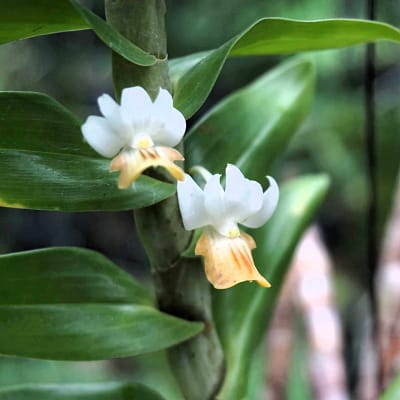
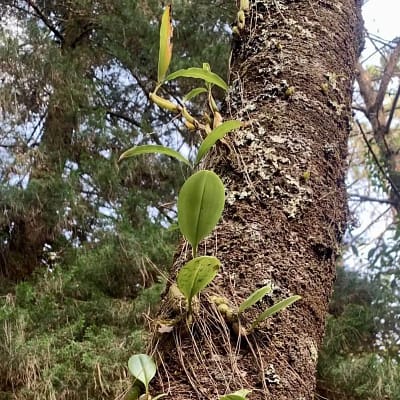
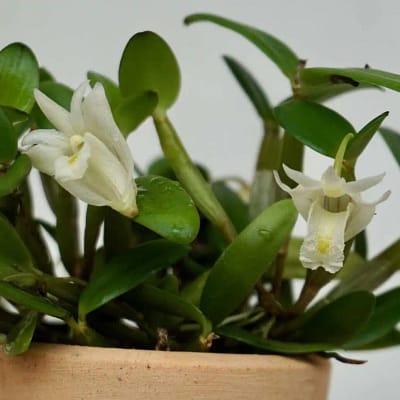
5. Dendrobium pachyphyllum (The Thick-Leaved Dendrobium)
This miniature, creeping epiphyte is tailored for terrarium culture or mount enthusiasts who enjoy subtle, intricate varieties.
- Bloom Appearance: Small, ephemeral, white-to-pale-pink flowers emerging from the tops of short, flattened pseudobulbs.
- Light Requirements: Medium, dappled shade. It cannot handle the intense, direct sun that larger Dendrobiums prefer.
- Temperature: Warm to intermediate.
- Watering Needs: Needs constant moisture with brief drying windows. Mounting on tree fern or cork bark with a small pad of sphagnum moss maintains the perfect moisture gradient.
- Grower Tip: The flowers open simultaneously and often last only a single day, but a mature specimen can bloom repeatedly throughout the summer months.
6. Vanda falcata (The Wind Orchid)
Steeped in Japanese history, Vanda falcata (formerly Neofinetia falcata) is a cold-hardy miniature orchid that produces architectural, pure white flowers in early summer.
- Bloom Appearance: Sparkly, pristine white blooms characterized by an exceptionally long, elegant nectar spur curving beneath the flower. It releases an intense, vanilla-jasmine scent at dusk.
- Light Requirements: Bright, filtered light.
- Temperature: Highly adaptable; tolerates winter chill down to near freezing, but actively grows and blooms in warm summer conditions.
- Watering Needs: Keep evenly moist but not waterlogged during June. Traditionally grown in mounds of long-fibered sphagnum moss on open pots to optimize airflow to the roots.

7. Renanthera matutina
If you want a dramatic focal point, Renanthera matutina provides a branching architectural look. This large monopodial orchid is built for high-energy environments.
- Bloom Appearance: Narrow, elongated petals in striking shades of reddish-orange and yellow, resembling leaping flames or a vibrant sunrise.
- Light Requirements: Very high light. It can tolerate some direct morning sun, which is necessary to induce reliable blooming.
- Temperature: Hot. This species reaches peak performance when summer temperatures climb.
- Watering Needs: Copious water during active summer growth. Grown best in large baskets or pots with coarse, fast-draining chunks of charcoal and bark.
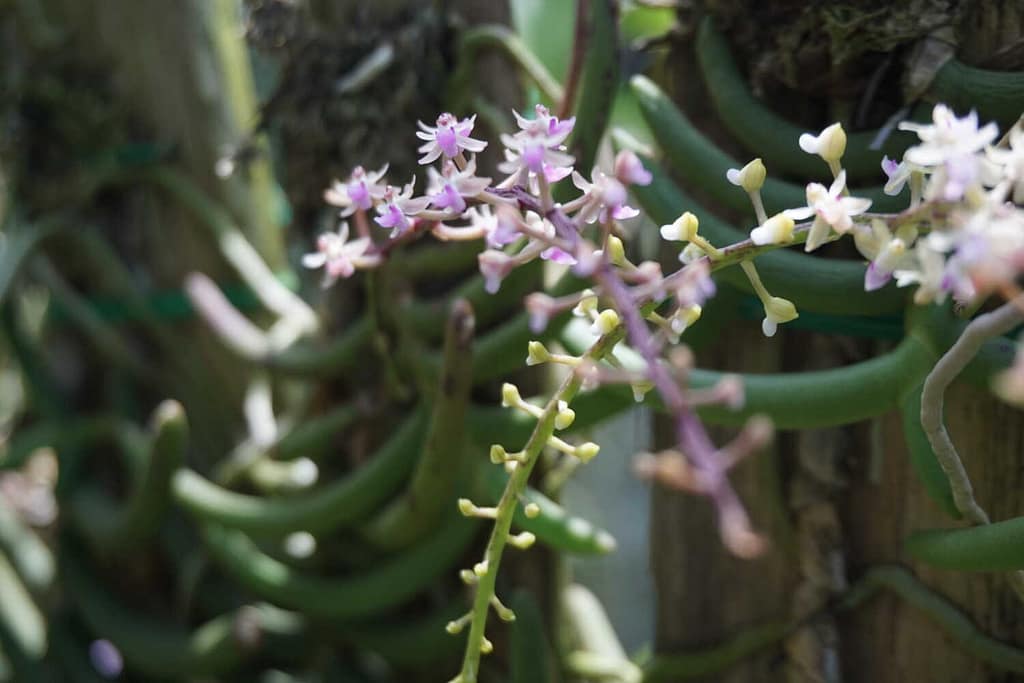
8. Cleisostoma arietinum (The Ram-Head Cleisostoma)
A fascinating miniature species for collectors who appreciate intricate floral morphology. Its foliage is terete (pencil-like and cylindrical), which is an evolutionary adaptation designed to conserve water in arid periods.
- Bloom Appearance: Pendent inflorescences bearing tiny, structurally complex flowers that resemble the head of a ram. Colors range from muted cream to purplish-brown.
- Light Requirements: Bright, indirect light to full morning sun.
- Temperature: Warm conditions are preferred for summer development.
- Watering Needs: Requires rapid wet-and-dry cycles. Because its terete leaves store water efficiently, it is highly sensitive to stagnant moisture at the root zone. Mount it bare on cork bark.
Comparative June Orchid Care Matrix
This reference matrix summarizes the cultivation parameters for each species during the peak summer month of June:
| Orchid Species | Growth Habit | Ideal Mounting/Potting | Light Level | Watering Frequency (June) | Primary Appeal |
| D. thyrsiflorum | Sympodial | Coarse Bark Mix / Basket | Bright Indirect | 3–4x per week | Massive white & gold clusters |
| D. densiflorum | Sympodial | Coarse Bark Mix / Basket | Bright Indirect | 3–4x per week | Golden monochromatic blooms |
| Vanda nana | Monopodial | Bare Root / Vanda Basket | Very Bright | Daily (Misting) | Brilliant pink miniature spikes |
| Rhy. coelestis | Monopodial | Open Slatted Wooden Basket | Bright Indirect | Daily (Misting) | Indigo blue tips & sweet fragrance |
| D. pachyphyllum | Sympodial | Cork Mount / Terrarium | Medium Shade | 4–5x per week | Miniature creeping habit |
| Vanda falcata | Monopodial | Sphagnum Mound / Small Pot | Bright Filtered | 2–3x per week | Evening scent & historic lineage |
| Ren. matutina | Monopodial | Large Coarse Pot / Basket | High / Direct AM | Daily | Fiery orange architectural displays |
| Cleis. arietinum | Monopodial | Bare Cork Mount | Bright Indirect | Daily (Misting) | Terete foliage & unique ram shapes |
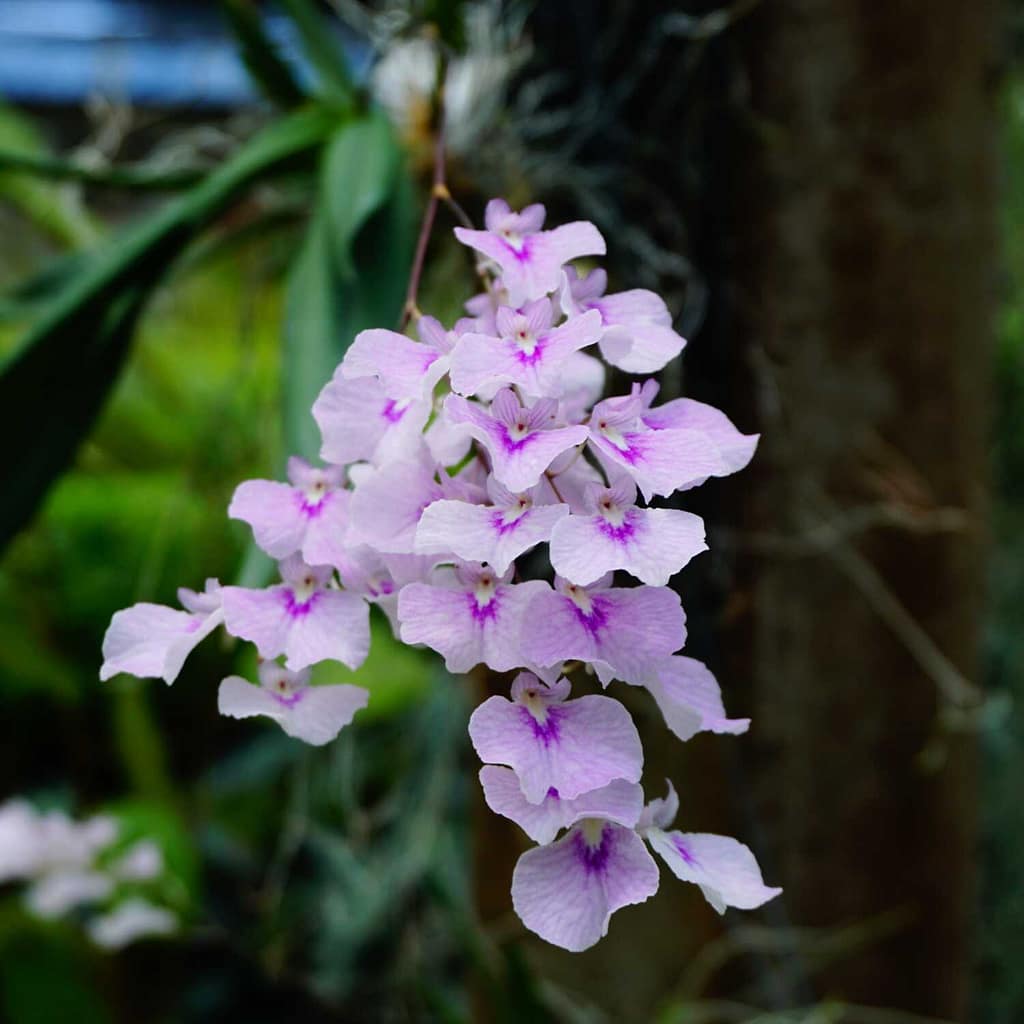
| Ion. utricularioides | Sympodial | Twig / Fine Bark Mount | Medium Shade | 3–4x per week | Delicate lavender cloud-like sprays |
Crucial June Care Adjustments for Summer Success
To keep these species healthy when temperatures peak in June, adjust your standard cultivation approach across four core areas:
1. The Interplay of Humidity and Air Movement
As temperatures exceed 30°C (85°F), an orchid’s respiration rate rises dramatically. To prevent heat stress:
- Maintain a relative humidity level between 65% and 80%.
- Pair high humidity with increased ventilation. Stagnant, humid air creates a breeding ground for bacterial soft rot (Erwinia) and fungal crown rot.
- Deploy oscillating fans around your growing area to keep air constantly moving over the leaves, lowering surface temperatures via evaporative cooling.
2. Strategic Summer Watering Protocols
In June, orchids process water faster due to transpiration.
- Water early in the morning (between 6:00 AM and 8:00 AM) to ensure standing water in leaf axils or crowns evaporates before the hot midday sun hits.
- Mounted and bare-root orchids require daily saturation, sometimes twice on days with low ambient humidity or high winds.
- Always check that potted mediums are warm-to-the-touch, not hot and soggy, as wet media at high temperatures will quickly cook delicate root tips.

3. Nutrient Delivery During Active Growth
Because June is a period of rapid vegetative growth and blooming for these species, their nutritional demands peak:
- Apply a balanced, water-soluble fertilizer weekly using a “weakly, weekly” philosophy (diluted to 1/4 or 1/2 of the manufacturer’s recommended strength).
- Flush your pots thoroughly with pure water once every three waterings to wash away accumulated fertilizer salts, which can burn root tips and cause leaf-tip dieback.

4. Pests and Disease Management
The onset of summer heat accelerates the reproductive cycles of common orchid pests:
- Inspect leaf joints and the undersides of leaves weekly for spider mites, thrips, and mealybugs.
- Maintain space between your plants; crowding limits airflow and allows pests to spread across your collection undetected.
- Treat early infestations immediately with insecticidal soap or horticultural oil, applying treatments exclusively during evening hours to avoid phytotoxicity (sunburning caused by oil cooking in direct sunlight).
By selecting species adapted to summer conditions and adjusting your care routine to account for the seasonal heat, your greenhouse can remain a vibrant, colorful space throughout June.