








Highlights
- Native habitat: Western Malesia to the Philippines — Brunei, Sumatra and Kalimantan (Indonesia), Peninsular Malaysia, Sabah and Sarawak (Malaysia), and possibly the Philippines
- Bloom season: Late spring to summer
- Fragrance: Yes — richly honey-sweet
- Difficulty: Easy
- Mature size: Large
Description
Natural History
Coelogyne pandurata, the celebrated “Black Orchid,” ranges across the lowland and hill forests of western Malesia, from Brunei and Sumatra through Kalimantan, Peninsular Malaysia, Sabah, and Sarawak — where it is the official state flower. In the wild it grows as a climbing or creeping epiphyte, and occasionally as a lithophyte on rocks, from near sea level up to about 1,000 meters.
Flowers
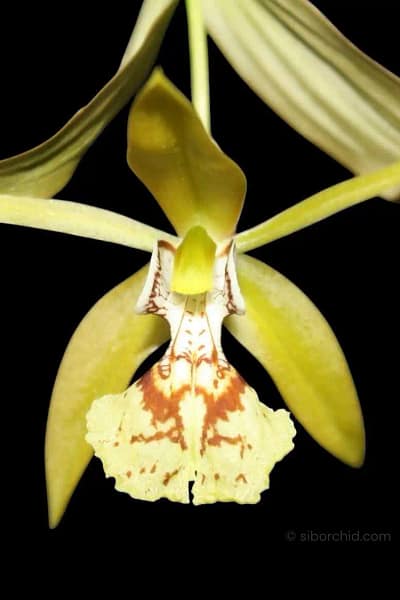
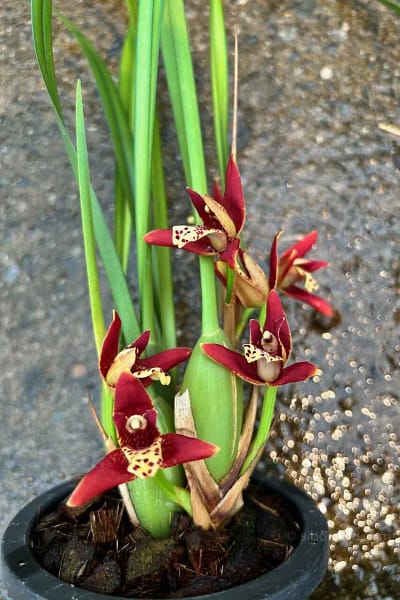
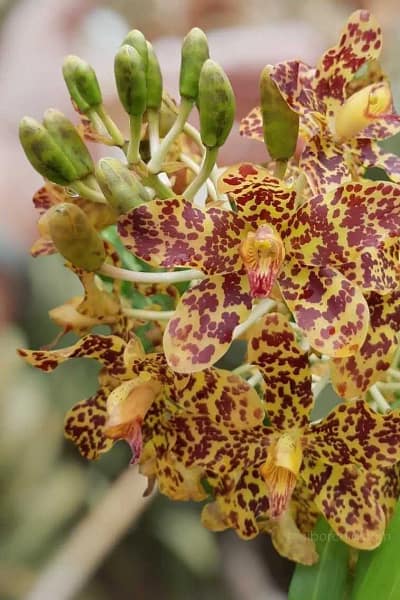
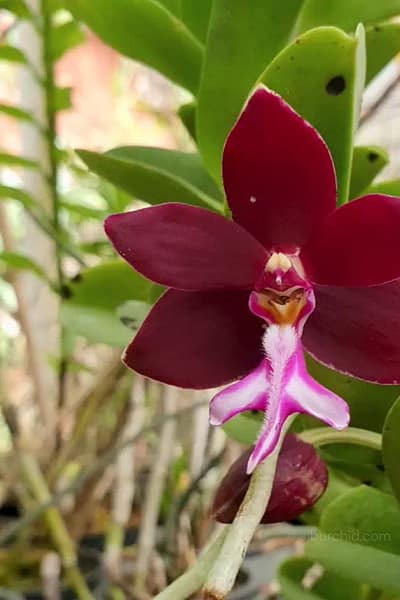
True to its name, this orchid produces one of the most striking blooms in the genus. From new growths in late spring or summer, an arching to pendant spike carries 5 to 9 flowers — up to 15 on a well-grown plant — each 3 to 5 inches across. Apple-green sepals and petals frame a long, dramatically warted lip marked in near-black, and the whole display fills the air with a rich, honey-sweet fragrance.
Growth Habit
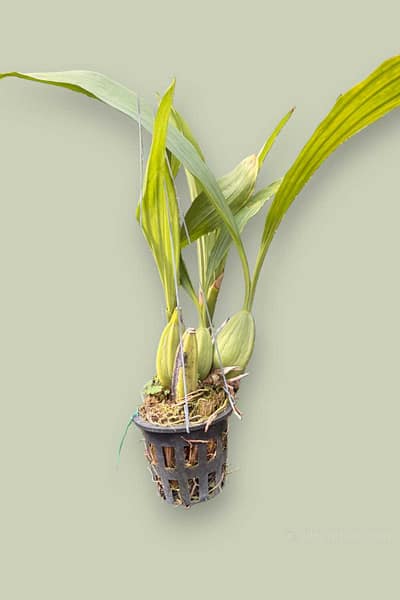
A vigorous, large-growing epiphyte, it forms flattened green pseudobulbs spaced along a thick, creeping rhizome, each topped with two broad, pleated leaves. Left to mature, your Coelogyne pandurata builds into a substantial, floriferous specimen clump — a true collector’s centerpiece.
Care Guide
LIGHT: Your Coelogyne pandurata does best in bright, partial shade — filtered light rather than full sun.
TEMPERATURE: A warm-to-intermediate grower, comfortable in typical greenhouse or windowsill conditions year-round.
HUMIDITY: Appreciates consistently high humidity with good air movement around the roots and foliage.
WATER: Water regularly through the growing season, tapering off gradually in winter — this plant is almost always in some stage of active growth, so keep the medium evenly moist rather than letting it dry out fully.
FERTILIZER: Feed regularly at a balanced, diluted strength during active growth; ease back slightly in cooler months.
MOUNTING/POTTING: Best grown in a basket with a coarse, fast-draining medium such as fir bark — this gives the creeping rhizome room to spread and lets the pendant flower spikes hang freely.
Specifications
| Botanical name | Coelogyne pandurata Lindl. |
| Family | Orchidaceae |
| Origin | Western Malesia to the Philippines (Brunei, Indonesia, Malaysia, possibly Philippines) |
| Plant size | Blooming size |
| Flower size | Approximately 3–5 inches (7.5–12.5 cm) |
| Bloom season | Late spring–summer |
| Growth habit | Epiphytic, occasionally lithophytic; creeping rhizome with pseudobulbs |
| CITES status | Appendix II |